As you win a first-time customer, you might expect them to return naturally based on product quality or competitive pricing. However, this dangerous assumption rarely pays off in the FMCG sector. The harsh reality is: without post-purchase follow-ups, most first-time buyers disappear and never look back. This isn’t the product’s problem in most cases. It’s a communication failure due to the lack of a structured FMCG email marketing funnel.
We never treat the first checkout as the end of the journey. Instead, we invest in efficient email marketing funnels for FMCG brands. This system guides customers through every stage of their relationship with the brand to secure 2-way communication and a long-term relationship.
In this blog, we share secrets for building successful email funnels for FMCG brands that go far beyond awareness to advocacy.
Struggling to turn one-time buyers into loyal customers? Our email marketing services can help you build automated customer journeys that strengthen engagement, encourage repeat purchases, and support long-term brand growth.
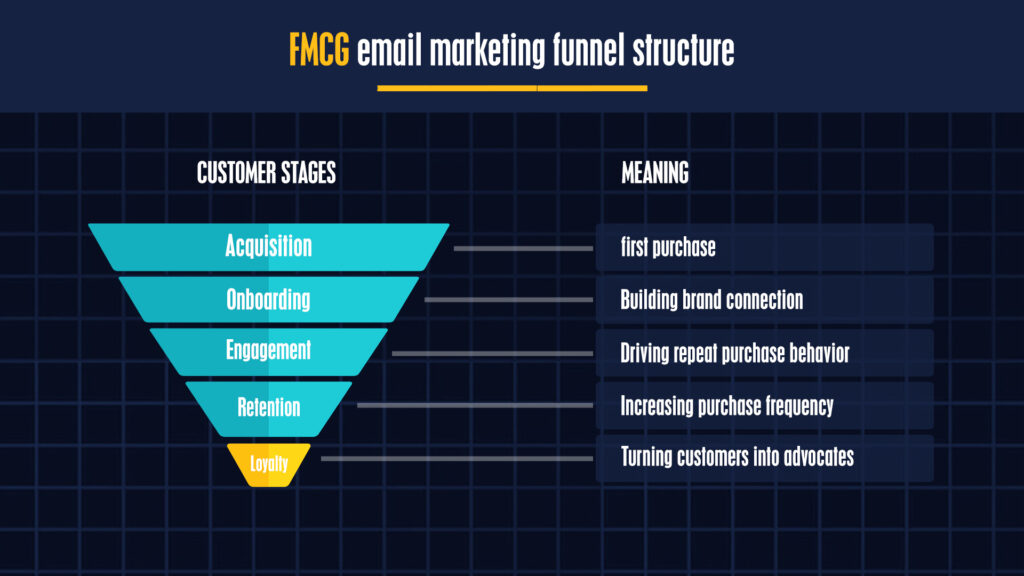
FMCG Email Marketing Funnel Structure Explained
Contrary to what most brands believe, email marketing isn’t a standalone promotional tool. That’s why they use it occasionally to announce new launches or seasonal offers. They ignore the email funnel’s role in the customer’s journey or a customer’s stance in the relationship with the brand.
A systematic and structured FMCG email marketing funnel works differently. It builds communication around the customer’s lifecycle. It’s a staged progression, rather than a static block. Each one of them serves a distinct purpose. For example, one welcomes first-time buyers, another encourages repeated purchases, and one establishes roots for brand advocacy.
1- Acquisition
This is when you capture the first purchase opportunity. This stage is critical because it makes or breaks the customer’s future with the brand. To avoid making customers bid you farewell, make sure they receive post-purchase checkouts. For example, sending an email thanking customers for a purchase and encouraging them to try future engagements. The goal isn’t to get customers back to a supermarket, but to keep your brand present in their minds.
2- Onboarding For FMCG Email Marketing Funnel
It’s the moment where you build a brand connection. It must immediately follow the acquisition trigger. Don’t make it appear as a sales pitch. Instead, it should be centered around relationship architecture, as in you keep them interested and waiting for more.
At the onboarding phase, your email marketing content must focus on:
- Brand Story: Make it simple and human. Don’t just summarize your mission and vision into an email. Give them a reason to relate to your brand emotionally. It’s not enough that your products use ethically sourced packaging materials because you care about the environment. You need them to feel confident that their everyday purchases contribute to a broader environmental goal, not to your company’s achievements.
- Product Range and Practical Usage: Don’t retype the ingredients and health benefits. Instead, inspire them with recipes that can use your products or offer tips for ideal storage or product pairings.
- Value Proposition: Make some of these messages a reminder of why you stand out and why they chose you.
3- Engagement
The goal of this stage is to trigger repeated purchases. But you should never explicitly state this in your emails. Your approach for this structured FMCG email marketing funnel is to push more content related to lifestyle ideas and daily routines. For F&B brands, we always recommend using real-life consumption moments as a gateway to customers’ minds. For example, push ideas with your products as a part of breakfast routines, Suhoor, snacks, movie nights, BBQ gatherings, or weekend picnics.
This is similar to how Graza approaches their FMCG email marketing funnel. According to a case study on Graza’s email marketing strategy, the olive oil brand relies on recipes, customer stories, and lifestyle content for newsletter content.
Need more guidance on customer engagement, retention, and lifecycle marketing? Subscribe to our newsletter today for practical FMCG marketing insights, industry trends, and actionable strategies delivered straight to your inbox.
4- Retention For FMCG Email Marketing Funnel
Compared to durable goods, retention is measured for FMCG products by repeated consumption. For that reason, the email marketing funnel for FMCG brands must be tied to usage cycles. As with the rest of the stages, it can’t be random or manual work. You need automation to take over the process. Your automated system must calculate average consumption rates that trigger precise consumer behavior trends.
Content ideas for this stage include:
- Replenishment Reminders: Your message should land in consumers’ inboxes right before they hit the markets, for instance, on a weekly, monthly basis, or re-order cycles.
- Cross-sell Flows: When you introduce complementary products that maximize the experience. For example, dipping sauces with your potato chips, a flavor-rich juice that goes well with your breakfast options, or a specialized spatula made to comfortably and cleanly scoop beauty creams.
- Win-Back Protocol: This intervention targets inactive customers and aims to attract them again before they quit on you through personalized “we miss you” reminders.
5- Loyalty
As the funnel’s final stage, loyalty moves far away from commercial transactions. At this point, repeated purchases are somehow secured. What makes a difference here is to turn them into enthusiastic fans or loyal advocates by rewarding them for coming all this way. You can do this by unlocking exclusive experiences and incentives that make them feel special and appreciated.
- Early Access to trial products
- Exclusive promotions
- Featured UGC
- Community building requests
- Review requests
Why Segmentation Matters in FMCG Email Marketing Funnel?

When talking about segmentation, we see many brands fully committed to categorizing their audience by age, gender, and location. They never look beyond that. As a result, they end up sending the same message to a large mass of subscribers who barely share things in common. But what we seek in segmentation is filtering audiences so that we tailor content for them in each message. A message that reflects actual preferences and shopping cycles.
Take FMCG giants, like Nestlé, as an example. The brand expanded beyond traditional demographic blocks to invest in AI-powered “ Segment of One” systems. This model unifies data across e-commerce, CRM, and loyalty touchpoints. The goal isn’t just understanding their customers, but to anticipate their next purchases.
Segmentation Foundations for FMCG Email Marketing Funnel
But if following Nestlé’s footsteps isn’t an immediate option for your current infrastructure, we recommend improving email segmentation systems in the following ways:
- First-Time vs. Repeated Buyers: Offer educational content for new buyers, while repeated customers need offers and exclusive loyalty rewards.
- High-frequency vs. inactive Buyers: The first type may respond well to promos and incentives, while the latter needs motivational and re-engagement email campaigns.
- Shopping History and Category Preference: A customer who regularly purchases cold beverages may respond well to seasonal drink recommendations, while a customer interested in herbal teas is more likely to engage with wellness-oriented content.
Best Practices for FMCG Email Marketing Funnel in MENA and GCC Markets
In our experience supporting FMCG marketing initiatives across the region, a proper localization strategy for FMCG brands in MENA clicks well with the audiences. While they are highly exposed to global trends, culturally relevant communication still plays a major role in building trust and engagement. For that reason, FMCG brands should avoid simply translating global email campaigns. Messaging should be adapted to local consumption occasions, seasonal events, and cultural preferences to maintain relevance.
Also, we find that internet users in the region prioritize mobile-first email content that is short, with clean visuals, and well-organized.
Replace disconnected promotional emails with a structured FMCG email marketing funnel that supports customers throughout their lifecycle. With proper segmentation, automation, and relevant content, brands can build stronger relationships that encourage repeat purchases and long-term loyalty.
Not sure where to start? Reach out now to book a free consultation and discover how a lifecycle-driven email strategy can support your retention and growth goals.