
When planning brand expansion in the GCC and MENA, your priority is a localization strategy for FMCG brands in MENA. You typically get the best and most accurate translation for captions, creatives, and SEO-optimized landing pages. But at the moment of truth, your content still appears disconnected and inauthentic.
In FMCG marketing, localization isn’t about writing catchy phrases in fluent Arabic. It’s more about understanding the cultural context and expressing it in a way that clicks with target audiences.
Over years of helping brands establish their roots in the MENA and GCC markets, we have noticed that only a few brands have successfully mastered this equation. For us, it is not a language exercise. It’s a shift in the brand’s identity based on a fusion of market insights and cultural empathy.
Stay tuned as we share real-life examples of how local and global players launched product lines that resonate with local audiences and appear as authentic local market extensions.
Addressing your audience in MENA markets requires strong content that captures people’s habits and styles. Our media production service provides a competitive platform content that has a real impact on the shelf.
How Can a Localization Strategy for FMCG Brands in MENA Go Wrong?

Most brands follow a poor execution pattern when entering a new market. They think a big name is enough and judge local markets with the same Western criteria. They often ignore that local audiences build long-term trust differently. According to Forbes, brands don’t fail due to a lack of demand, but because they misread how consumers in local markets evaluate credibility and authority.
The problem also lies in missing the audience’s ability to form a comprehensive picture for each product on FMCG aisles. Consumers usually put products in contexts, such as family moments, religious occasions, and rooted consumption habits.
For a proper localization strategy for FMCG brands in MENA, we always recommend that brands stop acting as if they belong in the market during the early entry phase. Instead, they should position themselves as students who are learning the market and testing relevance.
Real-Life Examples of Localization Strategy for FMCG Brands in MENA
Our approach to help the brand stand out is simple: don’t localize global food campaigns by translation, but by integrating into the local market. We achieve this through localized value propositions and adaptation of content strategies.
1- L’Oréal Paris Going Beyond Literal Translation
L’Oréal was one of the pioneer players to adapt the “halal-certified” cosmetic product niche. A recent Globe News Wire Report indicates that it is one of the growing industries and is projected to reach 135.54 Bn USD in 2033.
L’Oréal has gone down this FMCG localization in the MENA route since the late 1990s, with more than a print on packaging. Beyond religious requirements, for most consumers in Muslim countries, halal labels are equivalent to purity and ethical production. The brand’s approach was a success because it offered more than Arabic messaging; product adjustments that fit well into cultural expectations.
2- Almarai Capturing Ramadan Moments for Localization Strategy for FMCG Brands in MENA
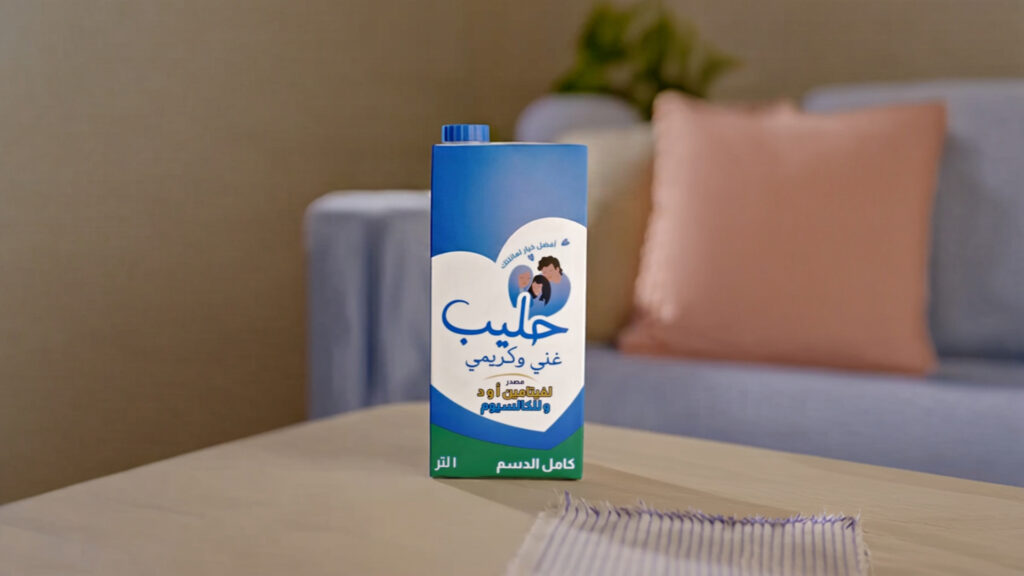
Almarai took a different path that was centered on storytelling campaigns. At the time, when most brands competed for the first “Ramadan Kareem themed posts, this brand focused on authentic Ramadan moments.
For years, the brand has been investing in featuring family gatherings and conversations around the Iftar or Sohour tables with their dairy products at the center. On the one hand, it showed how the product naturally fits into everyday routine. On the other hand, it positioned the brand as an integral part of the moment, not as a forced advertiser.
The brand has gone even further with a media approach that moves beyond interruption-based advertising. Instead, Al Marai became a part of the local media scene through a dedicated program on Shahid featuring authentic recipes from traditional Saudi cuisine.
Need more coverage on our approach to help international brands in MENA markets? Check out our detailed case study on how we helped St. Dalfour gain the trust of local consumers and align with retail dynamics.
3- Nestlé Unveils the Power of Personalization
When localizing, Nestlé avoided a fatal mistake of unifying messaging to the whole MENA region. Shopping habits and consumer needs vary from Riyadh to Cairo, and all the way to Casablanca. Their approach to address these markets is simply ditching global promos and relying on localized consumer data analysis.
Through this strategic intel gathering, the brand touched on changes in food culture as it has become less about indulgence and more about health. With these findings, Nestlé has launched multiple campaigns promoting health-based food categories.
4- Pepsi Avoiding Global Ad Repurposing

Recycling successful ad campaigns has been a safe choice for many brands. However, it rarely works as a reliable localization strategy for FMCG brands in MENA due to ignoring cultural nuance. What Pepsi does to avoid this trap is to tie its campaigns to locally defined consumption moments.
For instance, many Ramadan campaigns focus on the “completing gathering” concept. This is deeply tied to how the majority of MENA consumers experience the month with food, drinks, and social presence.
Simultaneously, the brand encourages consumers to contribute to campaigns using hashtags and UGC challenges.
Other campaigns leaned into nostalgia-driven storytelling by bringing back beloved movie, drama, or Ramadan-related Fawazeer stars for ads.
5- Arla Prioritizing Purpose over Product
Arla’s localization strategy for FMCG brands in MENA is based on wellness awareness and quality assurance. This meets the growing interest of younger households in Saudi Arabia, as many consumers look for clean-label and ethically sourced dairy products. The brand presents its image as a long-term partner in everyday healthy nutrition and balanced diets.
As we explored in the five case studies, these brands manage to achieve more than being randomly selected to become a reliable and aware choice for many FMCG shoppers across the MENA region.
Looking for help to restructure your localization strategy to actually drive adoption in MENA markets? Book a FREE consultation call with our team to define your new strategy.